Garden Glow Canvas Art Carol Robinson 24 X 24
Coordinates: 40°45′41.8″Northward 73°58′39.four″W / 40.761611°Northward 73.977611°W / forty.761611; -73.977611
 | |
 | |
 | |
| Established | Nov 7, 1929 (1929-11-07) |
|---|---|
| Location | 11 Westward 53rd Street Manhattan, New York City |
| Blazon | Art museum |
| Visitors | 706,060 (2020)[1] |
| Manager | Glenn D. Lowry |
| Public transit admission | Subway: Fifth Artery/53rd Street (  trains) trains)Jitney: M1, M2, M3, M4, M5, M7, M10, M20, M50, M104 |
| Website | world wide web |
The Museum of Modern Fine art (MoMA) is an art museum located in Midtown Manhattan, New York Metropolis, on 53rd Street between Fifth and 6th Avenues.
Information technology plays a major role in developing and collecting mod art, and is often identified as i of the largest and near influential museums of modern fine art in the world.[2] MoMA'south collection offers an overview of modern and contemporary art, including works of architecture and blueprint, drawing, painting, sculpture, photography, prints, illustrated books and artist'southward books, film, and electronic media.[3]
The MoMA Library includes approximately 300,000 books and exhibition catalogs, more than 1,000 periodical titles, and more than xl,000 files of ephemera near private artists and groups.[four] The archives hold primary source fabric related to the history of modern and contemporary fine art.[5]
It attracted 706,060 visitors in 2020, a drop of sixty-5 per centum from 2019, due to the COVID-19 pandemic. It ranked twenty-fifth on the list of nigh visited art museums in the globe in 2020.[vi]
History [edit]
Heckscher and other buildings (1929–1939) [edit]
The idea for the Museum of Mod Art was developed in 1929 primarily by Abby Aldrich Rockefeller (wife of John D. Rockefeller, Jr.) and two of her friends, Lillie P. Bliss and Mary Quinn Sullivan.[7] They became known variously as "the Ladies" or "the adamantine ladies".[viii] [9] They rented modest quarters for the new museum in the Heckscher Building at 730 Fifth Avenue in Manhattan,[viii] and it opened to the public on November 7, 1929, nine days afterward the Wall Street Crash.[10] Abby Rockefeller had invited A. Conger Goodyear, the former president of the board of trustees of the Albright Art Gallery in Buffalo, New York, to become president of the new museum. Abby became treasurer. At the fourth dimension, it was America's premier museum devoted exclusively to modern art, and the first of its kind in Manhattan to exhibit European modernism.[xi] One of Rockefeller'due south early recruits for the museum staff was the noted Japanese-American lensman Soichi Sunami (at that fourth dimension best known for his portraits of modern trip the light fantastic pioneer Martha Graham), who served the museum as its official documentary photographer from 1930 until 1968.[12] [thirteen]
Goodyear enlisted Paul J. Sachs and Frank Crowninshield to join him as founding trustees. Sachs, the acquaintance director and curator of prints and drawings at the Fogg Museum at Harvard University, was referred to in those days every bit a "collector of curators". Goodyear asked him to recommend a director and Sachs suggested Alfred H. Barr, Jr., a promising young protégé. Under Barr's guidance, the museum's holdings speedily expanded from an initial gift of eight prints and one drawing. Its first successful loan exhibition was in November 1929, displaying paintings by Van Gogh, Gauguin, Cézanne, and Seurat.[14]
First housed in 6 rooms of galleries and offices on the 12th floor of Manhattan's Heckscher Building,[xv] on the corner of Fifth Avenue and 57th Street, the museum moved into three more temporary locations within the next ten years. Abby Rockefeller's husband, John D. Rockefeller, Jr., was adamantly opposed to the museum (as well as to modern art itself) and refused to release funds for the venture, which had to exist obtained from other sources and resulted in the frequent shifts of location. Nevertheless, he eventually donated the state for the current site of the museum, plus other gifts over fourth dimension, and thus became in effect one of its greatest benefactors.[16]
During that time the museum initiated many more than exhibitions of noted artists, such every bit the lone Vincent van Gogh exhibition on Nov iv, 1935. Containing an unprecedented 60-six oils and fifty drawings from the netherlands, every bit well as poignant excerpts from the artist'south messages, it was a major public success due to Barr'southward arrangement of the exhibit, and became "a precursor to the hold van Gogh has to this 24-hour interval on the gimmicky imagination".[17]
53rd Street (1939–present) [edit]
1930s to 1950s [edit]
The museum also gained international prominence with the hugely successful and now famous Picasso retrospective of 1939–40, held in conjunction with the Fine art Institute of Chicago. In its range of presented works, it represented a significant reinterpretation of Picasso for future art scholars and historians. This was wholly masterminded by Barr, a Picasso enthusiast, and the exhibition lionized Picasso as the greatest artist of the fourth dimension, setting the model for all the museum's retrospectives that were to follow.[18] Boy Leading a Equus caballus was briefly contested over ownership with the Solomon R. Guggenheim Museum.[19] In 1941, MoMA hosted the ground-breaking exhibition, "Indian Fine art of the United States" (curated by Frederic Huntington Douglas and Rene d'Harnoncourt), that changed the way Native American arts were viewed by the public and exhibited in fine art museums.
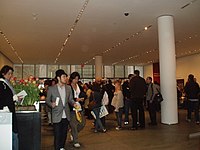
The entrance to The Museum of Modern Art
When Abby Rockefeller'south son Nelson was selected by the board of trustees to go its president, in 1939, at the age of thirty; he was a flamboyant leader and became the prime instigator and funding source of MoMA's publicity, acquisitions, and subsequent expansion into new headquarters on 53rd Street. His brother, David Rockefeller, also joined the museum'due south board of trustees, in 1948, and took over the presidency, when Nelson was elected Governor of New York, in 1958.
David subsequently employed the noted architect Philip Johnson to redesign the museum garden and name it in honor of his mother, the Abby Aldrich Rockefeller Sculpture Garden. He and the Rockefeller family in full general have retained a close association with the museum throughout its history, with the Rockefeller Brothers Fund funding the establishment since 1947. Both David Rockefeller, Jr. and Sharon Percy Rockefeller (married woman of old senator Jay Rockefeller) sit on the lath of trustees.[ citation needed ] After the Rockefeller Guest House at 242 East 52nd Street was completed in 1950, some MoMA functions were held in the house until 1964.[20] [21]
In 1937, MoMA had shifted to offices and basement galleries in the Time-Life Building in Rockefeller Middle. Its permanent and current home, now renovated, designed in the International Style by the modernist architects Philip L. Goodwin and Edward Durell Stone, opened to the public on May ten, 1939, attended by an illustrious company of 6,000 people, and with an opening address via radio from the White Business firm by President Franklin D. Roosevelt.[22]
1958 fire [edit]
On April 15, 1958, a burn down on the second floor destroyed an 18-foot (5.five m) long Monet Water Lilies painting (the electric current Monet Water Lilies was acquired shortly after the fire equally a replacement). The burn down started when workmen installing air-conditioning were smoking most paint cans, sawdust, and a canvas dropcloth. One worker was killed in the burn and several firefighters were treated for fume inhalation. Well-nigh of the paintings on the floor had been moved for the construction although large paintings including the Monet were left. Fine art work on the 3rd and 4th floors were evacuated to the Whitney Museum of American Art, which abutted it on the 54th Street side. Amid the paintings that were moved was A Sunday Afternoon on the Island of La Grande Jatte, which had been on loan past the Art Institute of Chicago. Visitors and employees in a higher place the fire were evacuated to the roof and then jumped to the roof of an adjoining townhouse.[23]
1960–1982 [edit]
In 1969, the MoMA was at the center of a controversy over its conclusion to withdraw funding from the iconic anti-war poster And babies. In 1969, the Art Workers Coalition (AWC), a group of New York City artists who opposed the Vietnam War, in collaboration with Museum of Modern Art members Arthur Drexler and Elizabeth Shaw, created an iconic protest poster called And babies.[24] The poster uses an image by photojournalist Ronald 50. Haeberle and references the My Lai Massacre. The Museum of Modernistic Art (MoMA) had promised to fund and circulate the affiche, only after seeing the two by iii human foot poster MoMA pulled financing for the project at the last minute.[25] [26] MoMA's Board of Trustees included Nelson Rockefeller and William S. Paley (head of CBS), who reportedly "hit the ceiling" on seeing the proofs of the affiche.[25] The poster was included shortly thereafter in MoMA's Information exhibition of July 2 to September 20, 1970, curated by Kynaston McShine.[27] Another controversy involved Pablo Picasso's painting Boy Leading a Horse (1905–06), donated to MoMA by William S. Paley in 1964. The status of the work every bit being sold under duress by its German language Jewish owners in the 1930s was in dispute. The descendants of the original owners sued MoMA and the Solomon R. Guggenheim Museum, which has another Picasso painting, Le Moulin de la Galette (1900), one time endemic by the same family, for return of the works.[28] Both museums reached a confidential settlement with the descendants before the case went to trial and retained their respective paintings.[xix] [29] [30] Both museums had claimed from the outset to be the proper owners of these paintings, and that the claims were illegitimate. In a joint statement the two museums wrote: "we settled merely to avoid the costs of prolonged litigation, and to ensure the public continues to have access to these important paintings."[31]
1980–1999 [edit]
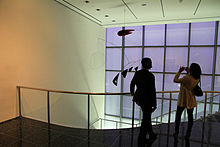
Stairs in the Museum of Modern Fine art

Cantankerous-section of the Museum of Modernistic Art
In 1983, the Museum more than doubled its gallery and increased curatorial department by 30 percent, and added an auditorium, two restaurants and a bookstore in conjunction with the structure of the 56-story Museum Tower bordering the museum.[32]
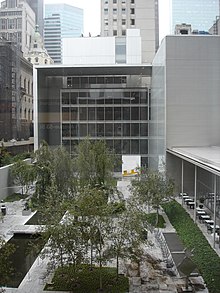
In 1997, the museum undertook a major renovation and expansion designed by Japanese architect Yoshio Taniguchi with Kohn Pedersen Fob. The project, including an increase in MoMA'southward endowment to comprehend operating expenses, cost $858 million in total. The project nearly doubled the infinite for MoMA's exhibitions and programs and features 630,000 foursquare feet (59,000 m2) of space. The Peggy and David Rockefeller Building on the western portion of the site houses the chief exhibition galleries, and The Lewis B. and Dorothy Cullman Education and Research Edifice provides space for classrooms, auditoriums, teacher training workshops, and the museum's expanded Library and Athenaeum. These two buildings frame the Abby Aldrich Rockefeller Sculpture Garden, which was enlarged from its original configuration.
21st century [edit]
The museum was closed for 2 years in connexion with the renovation and moved its public-facing operations to a temporary facility chosen MoMA QNS in Long Island City, Queens. When MoMA reopened in 2004, the renovation was controversial. Some critics thought that Taniguchi's design was a fine example of contemporary compages, while many others were displeased with aspects of the blueprint, such as the menstruum of the infinite.[33] [34] [35] In 2005, the museum sold state that it owned due west of its existing building to Hines, a Texas existent manor developer, under an understanding that reserved space on the lower levels of the building Hines planned to construct there for a MoMA expansion.[36]
In 2011, MoMA caused an adjacent building synthetic and occupied by the American Folk Art Museum on West 53rd Street. The building was a well-regarded structure designed by Tod Williams Billie Tsien Architects and was sold in connection with a financial restructuring of the Folk Art Museum.[37] When MoMA announced that information technology would demolish the building in connectedness with its expansion, there was outcry and considerable give-and-take about the issue, but the museum ultimately proceeded with its original plans.[38]
The Hines edifice, designed by Jean Nouvel and called 53W53, received construction approval in 2014.[39] Around the time of Hines' structure approval, MoMA unveiled its expansion plans, which embrace space in 53W53, as well every bit construction on the sometime site of the American Folk Fine art Museum.[xl] The expansion programme was developed by the architecture firm Diller Scofidio + Renfro in collaboration with Gensler. The first phase of construction began in 2014. In June 2017, patrons and the public were welcomed into MoMA to see the completion of the first phase of the $450 one thousand thousand expansion to the museum.[41]
Spread over three floors of the fine art mecca off Fifth Avenue are 15,000 square-feet (about i,400 square-meters) of reconfigured galleries, a new, second gift shop, a redesigned cafe and espresso bar and, facing the sculpture garden, two lounges graced with blackness marble quarried in France.[41]
The museum expansion project increased the publicly accessibly infinite by 25% compared to when the Tanaguchi edifice was completed in 2004.[42] The expansion allowed for fifty-fifty more of the museum'southward collection of nearly 200,000 works to exist displayed.[41] The new spaces also let visitors to enjoy a relaxing sit-down in one of the two new lounges, or fifty-fifty have a fully catered meal.[41] The two new lounges include "The Marlene Hess and James D. Zirin Lounge" and "The Daniel and Jane Och Lounge".[41] [43] The goal of this renovation is to assist expand the collection and brandish of work by women, Latinos, blacks, Asians, and other marginalized communities.[44] In connexion with the renovation, MoMA shifted its arroyo to presenting its holdings, moving abroad from separating the drove by disciplines such as painting, blueprint and works on paper toward an integrated chronological presentation that encompasses all areas of the collection.[42]
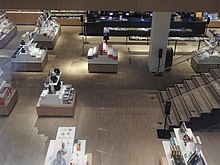
The Museum of Modernistic Art closed for another round of major renovations from June to October 2019.[44] [45] Upon reopening on October 21, 2019, MoMA added 47,000 square anxiety (iv,400 m2) of gallery space,[46] and its full floor surface area was 708,000 square anxiety (65,800 mtwo).[47] The expansion and refurbishment was overseen by the architectural business firm of Diller Scofidio + Renfro.[48] The institution began offering costless online classes in April 2014.[49]
Exhibition houses [edit]
The MoMA occasionally has sponsored and hosted temporary exhibition houses, which have reflected seminal ideas in architectural history.
- 1949: exhibition business firm by Marcel Breuer
- 1950: exhibition house by Gregory Own[50]
- 1955: Japanese Exhibition House by Junzo Yoshimura, reinstalled in Philadelphia, PA in 1957–58 and known at present as Shofuso Japanese Business firm and Garden
- 2008: Prefabricated houses planned[51] [52] [53] past:
- Kieran Timberlake Architects
- Lawrence Sass
- System Architects: Jeremy Edmiston and Douglas Gauthier
- Leo Kaufmann Architects
- Richard Horden
Artworks [edit]

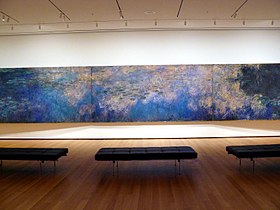
Claude Monet, Reflections of Clouds on the Water-Lily Pond, c.1920
Considered past many to have the all-time collection of mod Western masterpieces in the earth, MoMA's holdings include more than 150,000 individual pieces in improver to approximately 22,000 films and 4 million moving picture stills. (Access to the collection of motion picture stills ended in 2002, and the collection is mothballed in a vault in Hamlin, Pennsylvania.[54]) The collection houses such of import and familiar works as the following:
- Francis Salary, Painting (1946)
- Umberto Boccioni, The Metropolis Rises
- Paul Cézanne, The Bather
- Marc Chagall, I and the Village
- Giorgio de Chirico, The Vocal of Dear
- Salvador Dalí, The Persistence of Retention
- Max Ernst, Two Children Are Threatened by a Nightingale
- Paul Gauguin, Te aa no areois (The Seed of the Areoi)
- Albert Gleizes, Portrait of Igor Stravinsky, 1914
- Jasper Johns, Flag
- Frida Kahlo, Cocky-Portrait With Cropped Hair
- Roy Lichtenstein, Drowning Girl
- René Magritte, The Empire of Lights
- René Magritte, Imitation Mirror
- Kazimir Malevich, White on White 1918
- Henri Matisse, The Dance
- Jean Metzinger, Landscape, 1912–1914
- Piet Mondrian, Broadway Boogie-Woogie
- Claude Monet, Water Lilies triptych
- Barnett Newman, Broken Obelisk
- Barnett Newman, Vir Heroicus Sublimis (Human, Heroic and Sublime)
- Pablo Picasso, Les Demoiselles d'Avignon
- Jackson Pollock, Ane: Number 31, 1950
- Henri Rousseau, The Dream, 1910
- Henri Rousseau, The Sleeping Gypsy
- Vincent van Gogh, The Starry Dark
- Andy Warhol, Campbell's Soup Cans
- Andrew Wyeth, Christina's World
Selected collection highlights [edit]


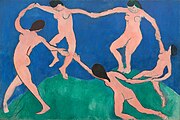


It also holds works past a broad range of influential European and American artists including Auguste Rodin, Henri Matisse, Pablo Picasso, Georges Braque, Joan Miró, Aristide Maillol, Piet Mondrian, Marcel Duchamp, Paul Klee, Fernand Léger, René Magritte, Henry Moore, Alberto Giacometti, Georgia O'Keeffe, Edward Hopper, Walker Evans, Dorothea Lange, Arshile Gorky, Hans Hofmann, Franz Kline, Willem de Kooning, Jackson Pollock, Mark Rothko, David Smith, Helen Frankenthaler, Morris Louis, Kenneth Noland, Robert Rauschenberg, Frank Stella, Andy Warhol, Roy Lichtenstein, and hundreds of others.
MoMA adult a world-renowned art photography collection starting time under Edward Steichen (1947–1961) and and so nether Steichen's manus-picked successor John Szarkowski (1962–1991), which included photos by Todd Webb.[55] The department was founded past Beaumont Newhall in 1940.[56] Under Szarkowski, it focused on a more than traditionally modernist approach to the medium, one that emphasized documentary images and orthodox darkroom techniques.
Pic [edit]
In 1932, museum founder Alfred Barr stressed the importance of introducing "the only great fine art grade peculiar to the twentieth century" to "the American public which should capeesh good films and support them". Museum Trustee and film producer John Hay Whitney became the first chairman of the Museum's Film Library from 1935 to 1951. The drove Whitney assembled with the help of film curator Iris Barry was then successful that in 1937 the Academy of Motion Pictures Arts and Sciences commended the Museum with an accolade "for its significant work in collecting films ... and for the first fourth dimension making available to the public the means of studying the historical and aesthetic development of the motility picture as 1 of the major arts".[57]
The kickoff curator and founder of the Moving-picture show Library was Iris Barry, a British pic critic and author, whose three decades of pioneering piece of work in collecting films and presenting them in coherent artistic and historical contexts gained recognition for the movie theatre as the major new art form of our century. Barry and her successors have built a collection comprising some eight thousand titles today, concentrating on assembling an outstanding drove of the of import works of international film art, with accent beingness placed on obtaining the highest-quality materials.[58]
The exiled film scholar Siegfried Kracauer worked at the MoMA film annal on a psychological history of German film between 1941 and 1943. The result of his study, From Caligari to Hitler: A Psychological History of the German Moving-picture show (1947), traces the nativity of Nazism from the movie house of the Weimar Republic and helped lay the foundation of modern film criticism.
Under the Museum of Mod Art Department of Motion picture, the picture show drove includes more than 25,000 titles and ranks as one of the world's finest museum athenaeum of international film art. The department owns prints of many familiar feature-length movies, including Denizen Kane and Vertigo, but its holdings too contains many less-traditional pieces, including Andy Warhol's eight-hour Empire, Fred Halsted's gay pornographic 50.A. Plays Itself (screened earlier a capacity audience on April 23, 1974), various TV commercials, and Chris Cunningham's music video for Björk'south All Is Full of Love.
Library [edit]
The MoMA library is located in Midtown Manhattan, with offsite storage in Long Island City, Queens. The non-circulating collection documents modernistic and contemporary fine art including painting, sculpture, prints, photography, film, performance, and architecture from 1880–present. The drove includes 300,000 books, 1,000 periodicals, and 40,000 files nearly artists and artistic groups. There are over eleven,000 artist books in the drove.[59] The libraries are open up past appointment to all researchers. The library'southward catalog is called "Dadabase".[4] Dadabase includes records for all of the cloth in the library, including books, artist books, exhibition catalogs, special collections materials, and electronic resources.[iv] The Museum of Modern Art'southward collection of artist books includes works by Ed Ruscha, Marcel Broodthaers, Susan Bee, Carl Andre, and David Horvitz.[threescore]
Additionally, the library has subscription electronic resources along with Dadabase. These include periodical databases (such equally JSTOR and Art Total Text), auction results indexes (ArtFact and Artnet), the ARTstor paradigm database, and WorldCat union catalog.[59]
Architecture and design [edit]
MoMA's Department of Architecture and Blueprint was founded in 1932[61] equally the starting time museum department in the world defended to the intersection of architecture and design.[62] The department's showtime director was Philip Johnson who served as curator between 1932–34 and 1946–54.[63] The adjacent departmental head was Arthur Drexler, who was curator from 1951 to 1956 and then served as head until 1986.[64]
The drove consists of 28,000 works including architectural models, drawings and photographs.[61] One of the highlights of the collection is the Mies van der Rohe Archive.[62] It too includes works from such legendary architects and designers as Frank Lloyd Wright,[65] [66] [67] [68] Paul László, the Eameses, Betty Cooke, Isamu Noguchi, and George Nelson. The design drove contains many industrial and manufactured pieces, ranging from a self-aligning ball bearing to an entire Bong 47D1 helicopter. In 2012, the section caused a choice of 14 video games, the basis of an intended collection of 40 that is to range from Pac-Human (1980) to Minecraft (2011).[69]
Management [edit]
Attendance [edit]
MoMA attracted 706,060 visitors in 2020, a drop of sixty-five percent from 2019, due to the COVID-19 pandemic. It ranked xx-5th on the List of most visited art museums in the globe in 2020.[6]
MoMA has seen its average number of visitors rise from nearly one.5 meg a year to 2.5 million after its new granite and glass renovation. In 2009, the museum reported 119,000 members and 2.eight meg visitors over the previous financial year. MoMA attracted its highest-ever number of visitors, 3.09 million, during its 2010 fiscal year;[70] however, omnipresence dropped 11 percent to 2.8 1000000 in 2011.[71] Omnipresence in 2016 was 2.8 1000000, down from 3.1 million in 2015.[72]
The museum was open every day since its founding in 1929, until 1975, when it closed 1 twenty-four hours a week (originally Wednesdays) to reduce operating expenses. In 2012, it again opened every day, including Tuesday, the one 24-hour interval it has traditionally been closed.[73]
Admission [edit]
The Museum of Modern Art charges an admission fee of $25 per adult.[74] Upon MoMA's reopening, its access cost increased from $12 to $20, making it ane of the most expensive museums in the city. Nevertheless, it has free entry on Fridays later on five:30pm, as part of the Uniqlo Gratis Friday Nights plan. Many New York area college students also receive free admission to the museum.[75]
Finances [edit]
A private non-profit organization, MoMA is the seventh-largest U.S. museum past budget;[76] its annual acquirement is about $145 million (none of which is profit). In 2011, the museum reported net avails (basically, a total of all the resources information technology has on its books, except the value of the art) of just over $1 billion.
Unlike most museums, the museum eschews government funding, instead subsisting on a fragmented budget with a one-half-dozen different sources of income, none larger than a fifth.[77] Before the economic crisis of tardily 2008, the MoMA'south board of trustees decided to sell its equities in order to motion into an all-cash position. An $858 1000000 capital entrada funded the 2002–04 expansion, with David Rockefeller donating $77 one thousand thousand in cash.[76] In 2005, Rockefeller pledged an boosted $100 million toward the museum's endowment.[78] In 2011, Moody's Investors Service, a bond rating bureau, rated $57 million worth of new debt in 2010 with a positive outlook and echoed their Aa2 bond credit rating for the underlying institution. The agency noted that MoMA has "superior financial flexibility with over $332 meg of unrestricted financial resources", and has had solid omnipresence and tape sales at its retail outlets around the city and online. Some of the challenges that Moody's noted were the reliance that the museum has on the tourist industry in New York for its operating acquirement, and a large amount of debt. The museum at the fourth dimension had a 2.4 debt-to-operating revenues ratio, but it was likewise noted that MoMA intended to retire $370 meg worth of debt in the next few years. Standard & Poor'southward raised its long-term rating for the museum as information technology benefited from the fundraising of its trustees.[79] After construction expenses for the new galleries are covered, the Modern estimates that some $65 million volition become to its $650 million endowment.
MoMA spent $32 meg to acquire art for the fiscal twelvemonth ending in June 2012.[fourscore]
MoMA employed about 815 people in 2007.[77] The museum'southward tax filings from the past few years advise a shift among the highest paid employees from curatorial staff to management.[81] The museum's director Glenn D. Lowry earned $i.6 million in 2009[82] and lives in a hire-free $6 1000000 apartment to a higher place the museum.[83]
MoMA was forced to shut in March 2020 during the COVID-19 pandemic in New York City.[84] Citing the coronavirus shutdown, MoMA fired its fine art educators in April 2020.[85] In May 2020, it was reported that MoMA would reduce its annual budget from $180 to $135 million starting July ane. Exhibition and publication funding was cutting past half, and staff reduced from around 960 to 800.[84]
Cardinal people [edit]
Officers and the board of trustees [edit]
Currently, the board of trustees includes 46 trustees and 15 life trustees. Fifty-fifty including the board'south fourteen "honorary" trustees, who practice not accept voting rights and practise not play as direct a part in the museum, this amounts to an average individual contribution of more than $vii million.[81] The Founders Wall was created in 2004, when MoMA'south expansion was completed, and features the names of actual founders in addition to those who gave significant gifts; about a one-half-dozen names have been added since 2004. For instance, Ileana Sonnabend'southward name was added in 2012, even though she was simply 15 when the museum was established in 1929.[86]
Board of trustees [edit]
Lath of trustees:
- Wallis Annenberg
- Sid R. Bass
- Lawrence B. Benenson
- Leon D. Black
- Clarissa Alcock Bronfman
- Patricia Phelps de Cisneros
- Edith Cooper
- Paula Crown
- David Dechman
- Anne Dias-Griffin
- Glenn Dubin
- John Elkann
- Laurence D. Fink
- Kathleen Fuld
- Howard Gardner
- Mimi Haas
- Alexandra A. Herzan
- Marlene Hess
- Jill Kraus
- Marie-Josée Kravis
- Ronald S. Lauder
- Thomas H. Lee
- Michael Lynne
- Khalil Gibran Muhammad
- Philip S. Niarchos
- James M. Niven
- Peter Norton
- Maja Oeri
- Michael S. Ovitz
- David Rockefeller Jr.
- Sharon Percy Rockefeller
- Richard Due east. Salomon
- Marcus Samuelsson
- Anna Marie Shapiro
- Anna Deavere Smith
- Jerry I. Speyer
- Ricardo Steinbruch
- Daniel Sundheim
- Alice Thou. Tisch
- Edgar Wachenheim 3
- Gary Winnick
Directors [edit]
- Alfred H. Barr, Jr. (1929–1943)
- No director (1943–1949; the job was handled past the chairman of the museum's coordination commission and the director of the Curatorial Section)[87] [88]
- Rene d'Harnoncourt (1949–1968)
- Bates Lowry (1968–1969)
- John Brantley Hightower (1970–1972)
- Richard Oldenburg (1972–1995)
- Glenn D. Lowry (1995–present)
Chief curators [edit]
- Philip Johnson, chief curator of architecture and design (1932–1934 and 1946–1954)
- Arthur Drexler, principal curator of architecture and blueprint (1951–1956)
- Peter Galassi, chief curator of photography (1991–2011)[56] [89]
- Cornelia Butler, chief curator of drawings (2006–2013)
- Barry Bergdoll, chief curator of compages and pattern (2007–2013)
- Rajendra Roy, chief curator of picture (2007–present)
- Ann Temkin, chief curator of painting and sculpture (2008–nowadays)[90]
- Klaus Biesenbach, director of MoMA PS1 and chief curator at large (2009–2018)
- Sabine Breitwieser, chief curator of media and performance art (2010–2013)
- Christophe Cherix, principal curator of prints and illustrated books (2010–2013), drawings and prints (2013–present)
- Paola Antonelli, managing director of enquiry and development and senior curator of architecture and design (2012–present)
- Quentin Bajac, principal curator of photography (2012–2018)
- Stuart Comer, chief curator of media and performance fine art (2014–nowadays)
- Martino Stierli, chief curator of architecture and design (2015–present)
Controversy [edit]
Women Artists Visibility Effect (W.A.5.East.) [edit]
On June fourteen, 1984 the Women Artists Visibility Event (W.A.V.E.), a demonstration of 400 women artists, was held in front of the newly renovated Museum of Modernistic Fine art to protest the lack of female representation in its opening exhibition, "An International Survey of Recent Painting and Sculpture". The exhibition featured 165 artists; simply fourteen of which those were women.[91] [92]
Art repatriation issues [edit]
The MoMA has been involved in several claims initiated by families for artworks lost in the Holocaust which ended upward in the collection of the Museum of Modern Fine art.[93]
In 2009, the heirs of German artist George Grosz filed a lawsuit seeking restitution of three works by Grosz, and the heirs of Paul von Mendelssohn-Bartholdy filed a lawsuit demanding the return of the painting past Pablo Picasso, entitled Boy Leading a Horse (1905–1906).[94] [95] [96]
In some other case, after a decade long court fight, in 2015 the MoMA returned a painting entitled Sand Hills past High german artist Ernst Ludwig Kirchner to the Fischer family because it had been stolen by Nazis.[97]
Strike MoMA [edit]
Strike MoMA is a 2021 movement to strike the museum targeting what its supporters have chosen the "toxic philanthropy" of the museum'south leadership.[98] [99]
See likewise [edit]
- Listing of museums and cultural institutions in New York City
- List of most-visited museums in the United States
- Dorothy Canning Miller
- Sam Hunter
- Solomon R. Guggenheim Museum
- Talk to Me (exhibition)
- The Family of Man showroom (1955)
- WikiProject MoMA
References [edit]
Citations [edit]
- ^ The Art Newspaper, List of most-visited museums in 2020, March 31, 2021
- ^ Kleiner, Fred S.; Christin J. Mamiya (2005). "The Development of Modernist Fine art: The Early on 20th Century". Gardner's Fine art through the Ages: The Western Perspective. Thomson Wadsworth. p. 796. ISBN978-0-4950-0478-3. Archived from the original on May x, 2016.
The Museum of Modernistic Art in New York City is consistently identified as the institution almost responsible for developing modernist art ... the about influential museum of modern art in the world.
- ^ Museum of Modern Art – New York Fine art World Archived February 23, 2009, at the Wayback Automobile
- ^ a b c "Library". MoMA. Archived from the original on February 5, 2016.
- ^ "Near the Archives". MoMA. Archived from the original on Feb 13, 2016.
- ^ a b The Art Paper almanac museum visitor survey, published March 31, 2021
- ^ "The Museum of Modern Art". The Art Story. Archived from the original on March xx, 2015. Retrieved May 12, 2015.
- ^ a b Meecham, Pam; Julie Sheldon (2000). Modernistic Art: A Critical Introduction. Psychology Press. p. 200. ISBN978-0-415-17235-6.
- ^ Dilworth, Leah (2003). Acts of Possession: Collecting in America. Rutgers University Press. p. 183. ISBN978-0-8135-3272-i.
- ^ Grieveson, Lee; Haidee Wasson (November 3, 2008). Inventing Film Studies. Duke University Press. p. 125. ISBN978-0-8223-8867-8.
- ^ FitzGerald, Michael (January 1, 1996). Making Modernism: Picasso and the Creation of the Market place for Twentieth-Century Fine art (reprint ed.). Berkeley: Univ of Calif Press. p. 120. ISBN978-0520206533 . Retrieved July 25, 2020.
Before the founding of the Museum of Modern Fine art in 1929, hardly any institution in the state—and none in Manhattan—would showroom European modernism.
- ^ Muir, Kathy. "Soichi Sunami". Seattle Photographic camera Social club . Retrieved December 31, 2014.
- ^ Smith, Roberta (September eleven, 2015). "Review: Picasso, Completely Himself in 3 Dimensions". The New York Times. Archived from the original on December 6, 2015. Retrieved December 3, 2015.
- ^ Harr, John Ensor; Peter J. Johnson (1988). The Rockefeller Century: Three Generations of America'due south Greatest Family. New York: Charles Scribner's Sons. pp. 217–xviii. ISBN978-0684189369.
- ^ Horsley, Carter B. "The Crown Building (formerly the Heckscher Building)". The City Review. Archived from the original on March viii, 2016. Retrieved January 21, 2008.
- ^ Kert, Bernice (1993). Abby Aldrich Rockefeller: The Adult female in the Family . New York: Random Firm. pp. 21, 376, 386. ISBN978-0812970449.
- ^ Kert 1993, p. 376.
- ^ FirzGerald 1996, pp. 243–62. sfn mistake: no target: CITEREFFirzGerald1996 (help)
- ^ a b Vogel, Carol (Dec 8, 2007). "2 Museums Go to Courtroom Over the Correct to Picassos". The New York Times. Archived from the original on July 1, 2017.
- ^ "Rockefeller Guest House" (PDF). New York City Landmarks Preservation Commission. December 5, 2000. Retrieved May i, 2021.
- ^ Stern, Robert A. M.; Mellins, Thomas; Fishman, David (1995). New York 1960: Architecture and Urbanism Betwixt the Second World War and the Bicentennial. New York: Monacelli Printing. pp. 305–306. ISBNone-885254-02-4. OCLC 32159240.
- ^ "Art: Beautiful Doings". Time. May 22, 1939. Archived from the original on January 29, 2008.
- ^ Allen, Greg (September 2, 2010). "MOMA on Fire". the making of: movies, art, &c. Archived from the original on January 22, 2014. Retrieved July 25, 2020.
- ^ Holsinger, M. Paul, ed. (1999). "And Babies". State of war and American Pop Culture: A Hisstorical Encyclopedia. Greenwood Press. p. 363. ISBN978-0313299087. Archived from the original on May 12, 2016.
- ^ a b Frascina, Francis (1999). Art, Politics, and Dissent: Aspects of the Fine art Left in Sixties America. Manchester Univ Press. pp. 175–186. ISBN978-0719044694. Archived from the original on June 10, 2016.
- ^ Sela, Peter Howard; Susan Landauer (Jan 9, 2006). Art of Engagement: Visual Politics in California and Across. Univ of California Press. p. 46. ISBN978-0520240520. Archived from the original on June 10, 2016.
- ^ Allan, Kenneth R. (December 15, 2003). "Understanding Information". In Corris, Michael (ed.). Conceptual Art, Theory, Myth, and Exercise. Cambridge: Cambridge University Press. pp. 147–148. ISBN978-0521823883.
- ^ "Pablo Picasso, Le Moulin de la Galette (1900)". Solomon R. Guggenheim Museum. Archived from the original on April 23, 2017.
- ^ Itzkoff, Dave (June 19, 2009). "Judge Rebukes Museums for Secret Picasso Settlement". The New York Times. Archived from the original on July 9, 2017.
- ^ Kearney, Christine (Feb 2, 2009). "NY museums settle in claim of Nazi-looted Picassos". Reuters. Archived from the original on December 1, 2017.
- ^ "Guggenheim Settles Litigation and Shares Key Findings" (Press release). Guggenheim Museum. March 25, 2009. Archived from the original on December i, 2017.
- ^ "Museum of Modern Fine art Expansion". Pelli Clarke Pelli Architects. Archived from the original on January 26, 2016. Retrieved July 25, 2020.
- ^ Updike, John (November xv, 2004). "Invisible Cathedral". The New Yorker. Archived from the original on September 26, 2014. Retrieved Dec 12, 2010.
Nothing in the new edifice is obtrusive, nix is inexpensive. It feels breathless with unspared expense. It has the enchantment of a banking company after hours, of a honeycomb emptied of honey and flooded with a soft glow.
- ^ Smith, Roberta (November i, 2006). "Tate Modern'south Rightness Versus MoMA'south Wrongs". The New York Times. Archived from the original on October 14, 2007. Retrieved February 27, 2007.
The museum's large, bleak, irrevocably formal lobby atrium ... is infinite that the Modern could sick afford to waste, and such frivolousness continues in its visitor amenities: the hard-to-observe escalators and elevators, the too-narrow glass-sided bridges, the two-star restaurant on prime garden real manor where there should be an affordable cafeteria ...Yoshio Taniguchi's MoMA is a cute edifice that apparently doesn't work.
- ^ Rybczynski, Witold (March 30, 2005). "Street Cred: Another Way of Looking at the New MOMA". Slate. Archived from the original on January twenty, 2012. Retrieved February 27, 2007.
- ^ Vogel, Carol (January three, 2007). "MoMA to Proceeds Exhibition Infinite past Selling Adjacent Lot for $125 Million". The New York Times. Archived from the original on Nov 16, 2017. Retrieved November 8, 2017.
- ^ Taylor, Kate (May x, 2011). "MoMA to Buy Building Used by Museum of Folk Art". The New York Times. Archived from the original on May 27, 2011. Retrieved September 25, 2014.
- ^ Pogrebin, Robin (April 1, 2014). "Architects Mourn Quondam Folk Art Museum Building". The New York Times. Archived from the original on November 9, 2017.
- ^ "53W53/MoMA Tower/Belfry Verre Finally Going Upwardly". citty.com. Archived from the original on May 23, 2015. Retrieved May 28, 2015.
- ^ Pogrebin, Robin (Jan 8, 2014). "A Chiliad Redesign of MoMA Does Not Spare a Notable Neighbor". The New York Times. Archived from the original on July 9, 2014. Retrieved September 29, 2014.
- ^ a b c d east "MoMA expanding its Manhattan space, view of NYC outdoors". WTOP News. Associated Press. June 2, 2017. Archived from the original on January 15, 2018. Retrieved January sixteen, 2018.
- ^ a b Pogrebin, Robin (June 1, 2017). "MoMA's Makeover Rethinks the Presentation of Art". The New York Times. Archived from the original on November 9, 2017. Retrieved Nov viii, 2017.
- ^ Gannon, Devin (May one, 2017). "MoMA reveals final design for $400M expansion". 6sqft. Archived from the original on January xvi, 2018. Retrieved January 16, 2018.
- ^ a b Pogrebin, Robin (February 5, 2019). "MoMA to Close, Then Open up Doors to More Expansive View of Art". The New York Times. ISSN 0362-4331. Retrieved Feb 21, 2019.
- ^ Hines, Morgan (October xvi, 2019). "'A new MoMA': New York's Museum of Modern Art reopening after $450 million expansion". USA Today . Retrieved Nov eighteen, 2019.
- ^ Paybarah, Azi (October 21, 2019). "MoMA Reopening: Everything You Need to Know". The New York Times. ISSN 0362-4331. Retrieved November 18, 2019.
- ^ "MoMA reopens with a $450 million mega-expansion and slick renovation". The Builder'southward Newspaper. October 16, 2019. Retrieved November 18, 2019.
- ^ Walsh, Niall Patrick (Feb 6, 2019). "MoMA Releases Opening Date and New Images of Major Diller Scofidio + Renfro Expansion". ArchDaily . Retrieved January xx, 2020.
- ^ Pull a fast one on, Alex (April xiv, 2020). "The Museum of Mod Art Now Offers Gratuitous Online Classes". Smithsonian . Retrieved July 25, 2020.
- ^ Denzer, Anthony (2008). Gregory Ain: The Modern Home as Social Commentary. Rizzoli Publications. ISBN978-0-8478-3062-half dozen. Archived from the original on June 17, 2008. Retrieved May 24, 2008.
- ^ "MoMA Announces Selection of Five Architects to Brandish Prefabricated Homes Exterior Museum in Summer 2008" (PDF). moma.org.
- ^ "Dwelling house Delivery: Frabricating the Modern Domicile". moma.org.
- ^ Pogrebin, Robin (January 8, 2008). "Is Prefab Fab? MoMA Plans a Show". The New York Times. Archived from the original on September 26, 2014. Retrieved May 24, 2008.
- ^ McDonald, Boyd; William E. Jones (2015). Cruising the Movies: A Sexual Guide to Oldies on TV. Due south Pasadena, Calif: Semiotext(e). p. 31. ISBN978-1584351719.
- ^ "Todd Webb, 94, Peripatetic Photographer". The New York Times. April 22, 2000. Archived from the original on Apr 3, 2012. Retrieved October 10, 2010.
- ^ a b Smith, Roberta (October 12, 1991). "Peter Galassi Is Modern's Photo Manager". The New York Times. Archived from the original on Nov 19, 2010. Retrieved September 25, 2014.
- ^ "History of MoMA Film Collection". MoMA. Archived from the original on Oct 12, 2012. Retrieved October 13, 2012.
- ^ The Museum of Modernistic Fine art, New York, Harry N. Abrams, Incorporated, New York, 1997, p. 527[ full citation needed ]
- ^ a b "Library Drove FAQ". MoMA. Archived from the original on Nov 4, 2015.
- ^ "Arcade". New York Art Resources Consortium . Retrieved July 25, 2020.
- ^ a b Broome, Beth (November four, 2011). "A Landmark Acquisition for MoMA's Architecture and Design Department". Architectural Record. Archived from the original on September vii, 2015.
- ^ a b Architecture and Design Archived March four, 2016, at the Wayback Machine, MoMA, retrieved November thirty, 2011
- ^ "Philip Johnson Papers in The Museum of Modernistic Art Archives, 1995". Archived March iv, 2016, at the Wayback Motorcar MoMA.
- ^ "Exhibition Records 1980–1989 in The Museum of Modern Art Archives", MoMA. 2016.
- ^ Medina, Samuel (January 24, 2014). "Frank Lloyd Wright Exhibition Set up to Open up at MoMA". Metropolis. Archived from the original on March 3, 2016.
- ^ Sullivan, Robert. "Urban Pattern: Frank Lloyd Wright'southward Archives on View at MoMA". Vogue. Archived from the original on March 3, 2016.
- ^ "Exhibitions: Frank Lloyd Wright and the City: Density vs. Dispersal". MoMA. Archived from the original on October five, 2015.
- ^ "Frank Lloyd Wright". MoMA . Retrieved July 25, 2020.
- ^ Antonelli, Paola (November 29, 2012). "Video Games: 14 in the Collection, for Starters". MoMA. Archived from the original on November thirty, 2012. Retrieved Nov 30, 2012.
- ^ Orden, Erica (June 29, 2010). "MoMA Attendance Hits Record Loftier". The Wall Street Journal. ISSN 0099-9660. Archived from the original on July 10, 2017. Retrieved June 25, 2020.
- ^ Boroff, Philip (January 12, 2012). "MoMA Visitors Fall, Met Museum'southward Rise, Led by Blockbusters". Bloomberg News. Archived from the original on January 11, 2015.
- ^ "Company figures 2016: Christo helps 1.2 meg people to walk on h2o". The Art Paper. Archived from the original on December 23, 2017. Retrieved December 22, 2017.
- ^ Vogel, Carol (September 25, 2012). "MoMA Plans to Exist Open up Every 24-hour interval". The New York Times. ISSN 0362-4331. Archived from the original on November 19, 2016. Retrieved June 25, 2020.
- ^ "Locations, hours, and admission". MoMA . Retrieved December 8, 2018.
- ^ "Discounts". MoMA. June 26, 2016. Retrieved December viii, 2018.
- ^ a b Boroff, Philip (August ten, 2009). "Museum of Modernistic Art'south Lowry Earned $1.32 Million in 2008–2009". Bloomberg News. Archived from the original on October 16, 2012.
- ^ a b Cohen, Arianne (May 1, 2007). "A Museum". New York. Archived from the original on March 5, 2016. Retrieved June 25, 2020.
- ^ Vogel, Ballad (April 13, 2005). "MoMA to Receive Its Largest Cash Gift". The New York Times. ISSN 0362-4331. Archived from the original on September 26, 2013. Retrieved June 25, 2020.
- ^ Kazakina, Katya (April xi, 2012). "South&P Raises Museum of Mod Art'due south Debt Rating on Management". Bloomberg News. Archived from the original on January 11, 2015.
- ^ Pogrebin, Robin (July 22, 2013). "Qatari Riches Are Ownership Art World Influence". The New York Times. ISSN 0362-4331. Retrieved June 25, 2020.
- ^ a b Eakin, Hugh (Nov 7, 2004). "MoMA's Funding: A Very Mod Art, Indeed". The New York Times. ISSN 0362-4331. Archived from the original on May 28, 2015. Retrieved June 25, 2020.
- ^ Boroff, Philip (August 1, 2011). "MoMA Raises Admission to $25, Paid Director Lowry $1.half dozen Million". Bloomberg News. Archived from the original on January 11, 2015.
- ^ Flynn, Kevin; Strom, Stephanie (August nine, 2010). "Plum Do good to Cultural Post: Tax-Free Housing". The New York Times. ISSN 0362-4331. Archived from the original on April 14, 2017. Retrieved June 25, 2020.
- ^ a b Kamp, Justin (May 7, 2020). "Museum of Modernistic Art Slashes Budget and Staff to Weather COVID-19". Artsy . Retrieved June 25, 2020.
- ^ McCarthy, Kelly (April six, 2020). "Coronavirus exposes vulnerability of NYC museums and museum workers". ABC News . Retrieved June 25, 2020.
- ^ Cohen, Patricia (Nov 28, 2012). "MoMA Gains Treasure That Met Too Coveted". The New York Times. ISSN 0362-4331. Archived from the original on November 28, 2012. Retrieved June 25, 2020.
- ^ "Promoted to Director Of Mod Art Museum". The New York Times. Archived from the original on July xix, 2014.
- ^ "A.H. Barr Jr. Retires at Modernistic Museum; Manager Since 1929 to Devote His Full Time to Writing on Art". The New York Times. October 28, 1943. Archived from the original on July 22, 2014.
- ^ Peces, Juan (Feb 12, 2018). "The definitive Brassaï show, curated by ex-MoMA star Peter Galassi". British Periodical of Photography . Retrieved July 25, 2020.
- ^ Smith, Jennifer (March 23, 2016). "MoMA Serves Upwardly a New '60s Mix". The Wall Street Periodical . Retrieved June 26, 2020.
- ^ Lubell, Ellen (June xix, 1984). ""Women March on MOMA"". The Village Vocalisation.
- ^ Shepard, Joan (June 15, 1984). ""Women Artists Picket MOMA"". New York Daily News.
- ^ "Practice Nosotros Need to Ship 'Monuments Men' to MoMA?". www.lootedart.com. Archived from the original on August 17, 2016. Retrieved January 9, 2021.
- ^ "New show in Grosz Nazi loot example against MoMA | The Art Newspaper". December 17, 2020. Archived from the original on Dec 17, 2020. Retrieved January ix, 2021.
- ^ "Schoeps v. Museum of Mod Art, 594 F. Supp. 2d 461 – CourtListener.com". CourtListener . Retrieved January nine, 2021.
- ^ "Haunting MoMA: The Forgotten Story of 'Degenerate' Dealer Alfred Flechtheim". www.lootedart.com . Retrieved Jan 9, 2021.
- ^ "New York museum returns painting stolen by Nazis after decade-long battle". www.lootedart.com . Retrieved January 9, 2021.
- ^ Pocket-sized, Zachary (May ane, 2021). "MoMA Blocks Protesters Who Planned to Demonstrate Within". The New York Times. ISSN 0362-4331. Archived from the original on Dec 28, 2021. Retrieved June 13, 2021.
- ^ "Activists' Program to Bring a March Confronting Toxic Philanthropy Inside MoMA Concluded in Conflicting Accounts of Violence". Artnet News. May 3, 2021. Retrieved June xiii, 2021.
Sources [edit]
- Allan, Kenneth R. "Agreement Information", in Conceptual Fine art: Theory, Myth, and Do. Ed. Michael Corris. Cambridge: Cambridge Academy Press, 2004. pp. 144–168.
- Barr, Alfred H; Sandler, Irving; Newman, Amy (Jan one, 1986). Defining modern art: selected writings of Alfred H. Barr, Jr . New York: Abrams. ISBN0810907151.
- Bee, Harriet S. and Michelle Elligott. Fine art in Our Time. A Chronicle of the Museum of Modern Art, New York 2004, ISBN 0-87070-001-four.
- Fitzgerald, Michael C. Making Modernism: Picasso and the Creation of the Market for Twentieth-Century Art. New York: Farrar, Straus and Giroux, 1995.
- Geiger, Stephan. The Fine art of Assemblage. The Museum of Modern Art, 1961. Die neue Realität der Kunst in den frühen sechziger Jahren, (Diss. Academy Bonn 2005), München 2008, ISBN 978-3-88960-098-one.
- Harr, John Ensor and Peter J. Johnson. The Rockefeller Century: Three Generations of America'south Greatest Family unit. New York: Charles Scribner'south Sons, 1988.
- Kert, Bernice. Abby Aldrich Rockefeller: The Adult female in the Family. New York: Random House, 1993.
- Lynes, Russell, Good Old Modernistic: An Intimate Portrait of the Museum of Mod Art, New York: Athenaeum, 1973.
- Reich, Cary. The Life of Nelson A. Rockefeller: Worlds to Conquer 1908–1958. New York: Doubleday, 1996.
- Rockefeller, David (2003). Memoirs. New York: Random House. ISBN978-0812969733.
- Schulze, Franz (June xv, 1996). Philip Johnson: Life and Work. Chicago: Academy Of Chicago Press. ISBN978-0226740584.
- Staniszewski, Mary Anne (1998). The Power of Display. A History of Exhibition Installations at the Museum of Modern Art. MIT Press. ISBN978-0262194020.
- Wilson, Kristina (2009). The Modern Centre: Stieglitz, MoMA, and the Art of the Exhibition, 1925–1934. New Haven: Yale Academy Press. ISBN978-0300149166.
- Lowry, Glenn D. (2009). The Museum of Modern Art in this Century. Museum of Modern Art. ISBN978-0870707643.
External links [edit]
- Official website
- MoMA Exhibition History Listing (1929–Present)
- MoMA Audio
- MoMA'south YouTube Channel
- MoMA's complimentary online courses on Coursera
- MoMA Learning
- MoMA Magazine
- Jeffers, Wendy (November 2004). "Abby Aldrich Rockefeller Patron of the modern". Magazine Antiques. 166 (55): 118. 14873617. Archived from the original on Feb 6, 2016. Retrieved January 28, 2016 – via EBSCOhost.
- " MoMA to Shut, Then Open up Doors to a More Expansive View of Art" New York Times, 2019
Source: https://en.wikipedia.org/wiki/Museum_of_Modern_Art
0 Response to "Garden Glow Canvas Art Carol Robinson 24 X 24"
Post a Comment